Creative Destruction

Our beginning and our end …

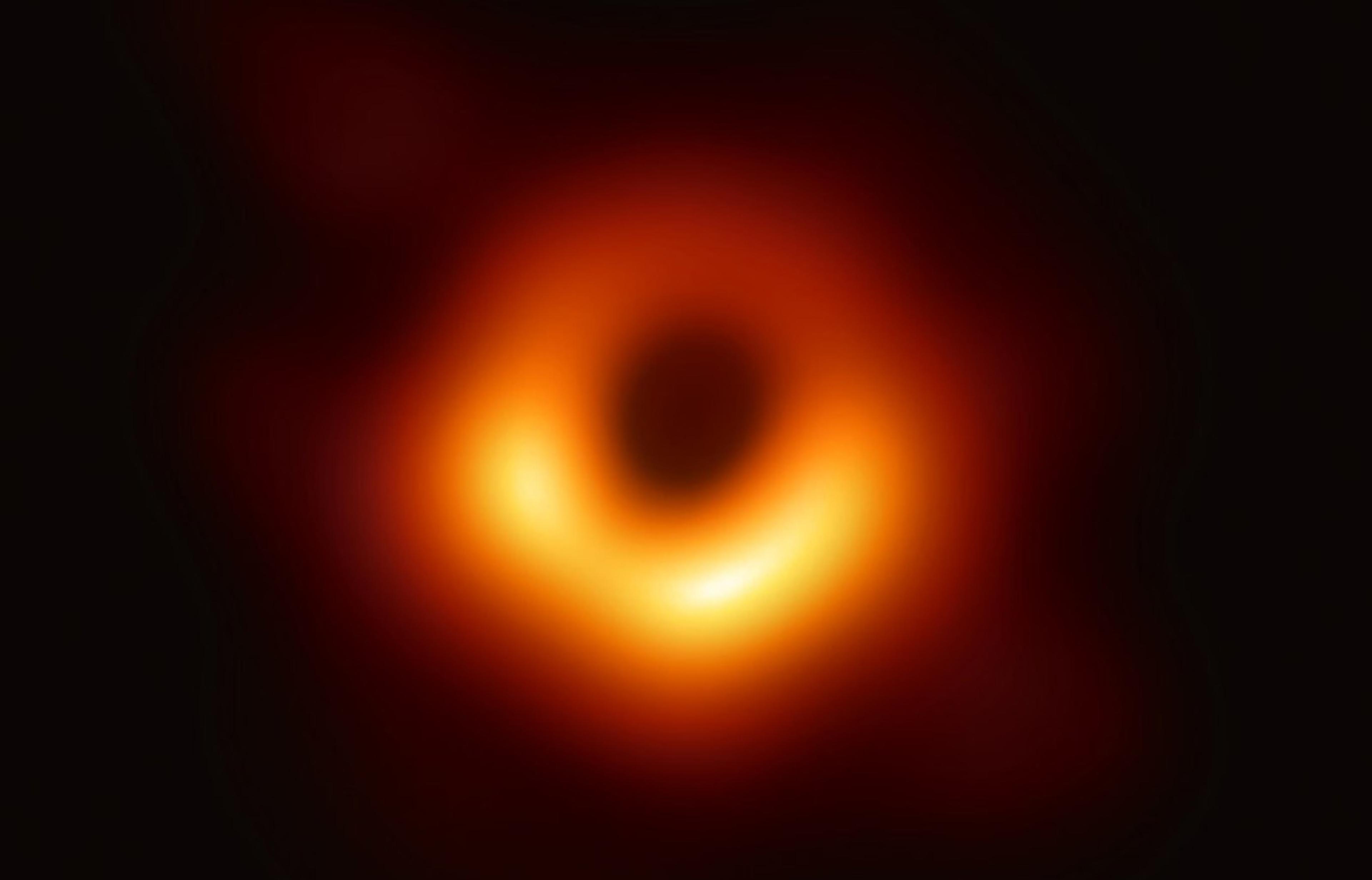
Photo of the first image of a black hole with a dark centre surrounded by a glowing, uneven ring of orange, yellow and red.

The new image of the black hole in the Messier 87 galaxy. L. Medeiros (Institute for Advanced Study), D. Psaltis (Georgia Tech), T. Lauer (NSF’s NOIRLab), and F. Ozel (Georgia Tech).
Source

What the image shows is the ‘photon ring’ that surrounds the gravitational mass of the  black hole. The photon ring is a boundary layer, the last gasp of light as it is dragged into the black hole (yes, that’s the void in the middle of the ring that we cannot actually see).

Interesting detail: the photon ring is brighter towards the bottom of the image because the ring is spinning mind-bogglingly fast and where the ring is brighter is the result of the Doppler effect – the brighter part of the ring is spinning towards us (…well, that’s the  hypothesis anyway!)

Even more beautiful is the black hole at the centre of our own galaxy: Sagittarius A*

Cromwell: A Biography

Have just read Diarmaid MacCulloch, ‘Thomas Cromwell: A Life’ (after watching the Mirror and the Light on telly.

It’s a very long book, not for the faint-hearted, very detailed. and an astonishing amount of research mostly based on original archive material (as far as I can tell).

Having read Mantel, and watched the TV adaptations as well as several programmes ‘investigating’ the Tudor period, there is much in this book to balance some of the more simplified representations of his life and character. He was a hard man for sure and used his power and influence for ends that in today’s world we cannot sanction. But his rise from relative ordinariness to become a of pivot of Tudor power as well a driver of religious Reformation is extraordinary.

Takeaways:

His father was not the brute he is made out to be in Mantel. That is a Victorian story and his family were, in today’s terms, successful middle-class people. He was, nevertheless, something of a wild kid!

He created several political and governmental practices we use today – the ‘division’ (handy, if you think about it, for identifying those who oppose a government line); the by-election to replace defunct of unwilling parliamentary participants); and he developed the role of printing as a tool for disseminating government policies and statutes, until then much more dependent on scribed documents. He was a Nicodemite (i.e. a covert Protestant; this likely played a significant role in his downfall along with the political mess created by the Cleves marriage), and was responsible  for printing and the compulsory distribution of the first English language bible (known as the Matthew bible because it was published under the false name of ‘Thomas Matthew’ whereas it was in fact a reprint of Tyndale’s bible!).

Perhaps one of his more interesting concerns (aside from the transformation-by-closure-and-requisition of the English church system) was to do with the state of rivers and the damage done by the uncontrolled use of weirs for a variety of purposes. For example, the River Itchen once provided navigable access from Winchester to the sea of Southampton but had become impassable and degraded as a result of the many weirs and mill ponds established along its course leading to silting, loss of flow. and navigation. Cromwell spent a lot of time removing many weirs and improving the quality of rivers.

See the section in the book on the ‘Commissions of sewers’. “In many ways, the work of these commissions over several centuries from 1532 created the modern geography of rural England: less spectacularly or rapidly than the Industrial Revolution, but cumulatively just as important in effect.”

The idea that Cromwell was a ‘rewilder’ is suggsted here https://www.inkcapjournal.co.uk/was-thomas-cromwell-the-first-rewilder/ and refers to Mantel’s story in the Mirror and the Light that he looked upon beavers as a necessary and useful animal for the maintenance of river health. This biography implies there was much more to than that. A useful study indeed for historians of environmentalism!

There is much more in the book that offers many, many hours of follow up though the sources that are cited are mostly original documents, so follow-up would be quite challenging. It’s a long read, lots of names, hard work if you want the details!

During 1530 to 1540 as the pace of reformation increased, the removal and destruction of shrines, tombs and religious artefacts grew more wanton. For example, by about 1537 scavengers were digging up wayside crosses in search of (non-existent) treasure that popular belief said lay buried beneath them! Cromwell’s ow cellars At Austin Friars were, apparently, stuffed with all kinds of seized holy objects (most eventually burned or otherwise destroyed).

Futures (from Kurt Vonnegut)

 1988: A vision of the future from Kurt Vonnegut:

Interesting to note that way back in 1909 this was pretty much the same vision as laid out by E.M.Forster in ‘The Machine Stops’. Here are Vonnegut’s headline bullet points:

1. Reduce and stabilize your population.

2. Stop poisoning the air, the water, and the topsoil.

3. Stop preparing for war and start dealing with your real problems.

4. Teach your kids, and yourselves, too, while you’re at it, how to inhabit a small planet without helping to kill it.

5. Stop thinking science can fix anything if you give it a trillion dollars.

6. Stop thinking your grandchildren will be OK no matter how wasteful or destructive you may be, since they can go to a nice new planet on a spaceship. That is really mean, and stupid.

7. And so on. Or else.

See also: Benedict Cumberbatch reads Kurt Vonnegut

============================

Futurism (Marinetti) was nuts, in a way we know so well!

Big Tech’s Partnership with Authoritarianism

Ereader reviews never tell you what it’s like to actually read with them …

I have always been perplexed, and annoyed, by reviews of ereaders that focus almost entirely on hardware issues – how fast, how sharp, how bright, how much memory, is it made of metal or plastic etc. Important details but, really, the issue is does it make reading a pleasant and satisfying experience? The technical stuff takes one or two sentences.

Reviewers hardly ever tell you what it is like to actually read books with them. They might say it is comfortable to hold in the hand but what is the highlighting system like, does it work easily when actually reading, can you retrieve and download your highlights (how do you do that, and in what format), is searching for words and phrases in the text managed well, does it provide easy to dictionaries and other internet resources, are page layouts and formats easily adjusted, does the ereader tie you in to a particular cloud service (and if so how easy is that to use?) etc. etc. 

No it;s always minor details about processors ad memory – important enough bu not the main reason for buying an ereader.

The situation has not improved now that we moved in to the era of ereader/notebook hybrids. In fact with notebooks the issue is even more important. Reviewers forget that there are at least two kinds of notebook users – journallers and workbooks. The former are well suited to eink notebooks for, by and large, they are ore likely to keep a notebook as a running, routine commentary on a topic. The man feature of journalling is that it is a continuous record, developed over time. A prose diary is the most obvious case.

For me at least, a workbook is much less coherent and usually involves a ore fragmentary approach. Entries are not necessarily sequential though they might be but never spread across an entire notebook. To coin a word, workbooks are ‘heterotopic’.   

So when I read reviews of eink notebooks I want to know what purposes they suit best. Like many people I have on three occasions decided, or been persuaded, to try them out because they seem like the next best thing (I’ve own a Boox, a reMarkable, and lately a Scribe). I do not currently have one because they do not suit my ‘workbook’ style – disparate notes – yes I’ll call them ‘jottings’  – that, when written into the ‘white box’ of an eink screen are not easily ‘retrieved’. 

But reviewers never tell you about these issues – how well does an eink notebook enable search and how easily do they all the writer to extract and organise retrievals into useful lists – much like ‘notes’ from a Kindle – No reviewer tells you about how tools for find, retrieve and organise scribbles from disparate sections of disparate workbooks. And I have yet to to find an eink notebook that does this.

This example is bit extreme, but it sums up how irrelevant so-called reiews can be. This one aims to be general – to cover 5 reasons why eink notebooks are great – but it never talks about note taking! 

https://www.xda-developers.com/e-ink-tablets-are-the-best-notetaking-devices

5: No more inky fingers (Ink! OK maybe but now excuse and can’t even use a pen correctly!)

4: Instant backups (doh! standard these days across almost all software’/hardware and especially handhelds

3: No more wasting paper (dubious – wasting? not if you are maintaining your paper notes; besides this is small beer compared with eh production footprint of devices)

2: I can do other tasks too (well, this isn’t the point is it?)

1: Handwriting recognition (agan, fair enough, but come on – if you can’t read your own handwriting what’s the point?)

Cables

This topic may seem to be getting old hat, but it will yet be some time before physical cables as a means of networking the world are abandoned.

Australia is connected to the world by cables no thicker than a garden hose – and at risk from sharks, accidents and sabotage | Internet https://www.theguardian.com/technology/2024/dec/02/australia-is-connected-to-the-world-by-cables-no-thicker-than-a-garden-hose-and-at-risk-from-sharks-accidents-and-sabotage

Video: What Happens When Undersea Internet Cables Snap? https://www.nytimes.com/video/world/africa/100000009778604/what-happens-when-undersea-internet-cables-snap.html

Wire cutters: how the world’s vital undersea data cables are being targeted https://www.theguardian.com/world/2024/nov/22/wire-cutters-how-the-worlds-vital-undersea-data-cables-are-being-targeted

https://archive.ph/fG9tc

https://www.bbc.com/news/science-environment-65174512

https://www.theguardian.com/environment/article/2024/aug/09/what-lies-beneath-the-growing-threat-to-the-hidden-network-of-cables-that-power-the-internet?CMP=Share_AndroidApp_Other

Borges

 From: Various contributors. 2013. Jorge Luis Borges: the last interview & other conversations. Melville House Publishing.

(1) “…if you think of life as a dream, there may be something gruesome or uncanny about it, and you may sometimes feel that you are living in a nightmare, but if you think of reality as something hard and fast, that’s still worse, no? I think that philosophy may give the world a kind of haziness, but that haziness is all to the good.”

(2)  asked about his teaching of  literature, he emphasised reading books instead of learning details about authors:

“As to the dates of their deaths, as they didn’t know them themselves, why should you know them? Why should you know more than the authors did?”

At first, this book seemed rather humdrum, but as you read it there are (i) some gems (e.g. see quotes above) and (ii) in the context of current debates about the impact of machine learning on creativity, and specifically on writing, Borges, when talking about his writing and reading, his teaching, his life in books and outside books, is a good example of the ways in which machine learning seems so reductionist.

It is hard to see how machine learning can ruminate about poetry  and literature in the way that Borges does, spontaneously yet generated from experience, with insights but also contradictions. There is too the magic of what can only be described as a ‘feeling’ for literature as a way of living, in large part based on the fact of his being blind, and the bright gaze of his imagination on writers as fictions in their own creations.

==============================

Post to BlueSky 28/11/24

As I ended reading the book of interviews with Borges (link below) I was struck that he exemplifies why machine learning as a generative source of literature is inherently limited, and why it cannot be otherwise … but not enough space in a post to explore that! 😔

Of course, I wouldn’t rule out machine learning as a helpmate but the imagination, embedded in lived experience, is (i) a priori and (ii) cannot be reproduced merely with words … even though great literature is made with words …

Elon Musk: psycho

Jon Ronson’s book ‘The Psychopath Test’ makes many references to examples of specific brain activity that signal of psychopathic propensity.

Of course, these signals only arise in relation to some stimulus – e.g. extreme images of mutilated bodies (psychopaths hardly react, or seek more details)

But is the signal a cause or a response? Is it inherent, i.e. it’s the way your brain is made, or can it be trained/socialised? Does the repeated exposure to horrifying images on Twitter (now rebuilt as a snuff porn hub) dull the signal or exaggerate it?

Or both? If it dulls, then people become indifferent to psychopathic stimuli, they are normalised; if it exaggerates it, well people become less subject to other controls that might exist  either within the psyche or externally to it.

In either case, driven by PsychoMusk’s love of violence-porn, Twitter fuels psychopathic tendencies, one video at a time.

Books (My ‘Oppenheimer List’)

The Development of the A-Bomb (and related matters such as quantum physics)

No doubt the arrival of the movie ‘Oppenheimer’ in 2023 stimulated many of us to read up on this transformative period of developments in applied science, specifically atomic physics. Astonishing, hair-raising, enthralling … here are some books, films and TV I have read/seen recently (Nov23 – Mar24) (I eventually watched the Nolan movie but was disappointed.) 

Books (in no particular order).

  • Ray Monk. 2012. Inside the Centre: The Life of J. Robert Oppenheimer.

Good on the science side. (Read this when it was published but have re-read it)

  • Kai Bird and Martin J. Sherwin.  2008. American Prometheus: The Triumph and Tragedy of J. Robert Oppenheimer

Good on Oppenheimer’s life before Los Alamos and the political/personal skullduggery of the tearing down of Oppenhiemer’s status.

  • Jennet Conant. 2005. 109 East Palace: Robert Oppenheimer and the Secret City of Los Alamos.

An excellent book, very readable. Great detail about the social aspects of Los Alamos and the extraordinary role of Dorothy McKibbin in managing the ‘interface’ between the secret city and the war-time civil world from an office in Santa Fe. Fills in many of the gaps in the biographies. Excellent on the psychological impact of the Trinity test and the bombing of Japan; has important perspective on the post-war security hearings and aspects of Oppenheimer’s personality.

  • Thomas Powers. 1993. Heisenberg’s War: The Secret History of the German Bomb.

A hair-raising story. In the biographies we learn only that the Allies were worried about Nazi progress on developing their own atomic weapons. This book makes you realise how real a threat that was. (NOt a great book because too much detail!) In the end the Nazi regime lacked the organisational finesse as well as visionary insight to make much progress. Speer’s attitude was key in dismissing the practical possibilities. Heisenberg, a key scientist for any attempt, seems at worst to have been, on the one hand a sincere patriot, but on the other, antagonistic towards the Nazis. He seems to have quite deliberately played down the possibility of constructing an atomic bomb but instead concentrated on the loner term possibilities for limitless energy supply though the development of reactors. This did not stop the Allies from worrying about what the Nazis were up to!

Startling is the extent to which there was a deep and genuine fear that while the Nazi’s own atom bomb programme was nowhere, the threat that bob payloads might use radioactive materials to poison land and people was taken very seriously indeed (especially after the development of the V1 and V2 rockets as delivery vehicles). Also note that Oppenheimer too had ‘cold-bloodedly’ drafted a scheme to poison German food supplies wht strontium. Such plans were much more feasible and practical in the absence of a bomb-programme.

It is a more exciting story than Oppenheimer’s given the amount of allied effort that went into intelligence work, as well as H’s lone ambivalence. It seems a little ironic that H was thought by more than a few to have been incompetent but hiding behind a moral posture, whereas Oppenheimer, who was competent, was ultimately ‘convicted’ by his moral position.

  • Lanouette, William & Szilard, Bella. 2013.  Genius in the Shadows: A Biography of Leo Szilard, the Man Behind the Bomb.

A fascinating man, one of the ‘discoverers’ of the atomic fission chain reaction that started it all. A combination of genius, dilettante, trickster, and all round humanist who was one of the first to realise, and to campaign against, the terrifying implications of the atomic bomb.

  • Ananyo Bhattacharya. 2021. The Man from the Future: The Visionary Life of John von Neumann.

A truly startling figure and one can only agree with the epithet ‘visionary’. The book covers the range of Neumann’s work across mathematics, games theory, automata, computing, and of course his contributions to the atomic and hydrogen bomb projects. Very interesting stuff. Bhattacharya provides one of the more complete descriptions of the constituent parts of an atomic bomb – surprisingly complex and not a bomb in the conventional sense!).

In general, in some of the books listed above, Neumann does not get the acknowledgement he deserves for his work in quantum mechanics and atomic theory, but the sources in Bhattacharya’s well written and affirmative book can help to flesh that out. Good content on Neumann’s work on defining the ‘balance of power’ during the Cold War. While fascinating a lot of this is also very scary stuff.

This book provides a very good overview of the intellectual environment surrounding the scientific and political issues of a momentous period in human history.

(see also Labatut, The Maniac.)

  • Gino Segre, 2007. Faust in Copenhagen.

More focus on the people behind the development of quantum physics, with more emphasis on Bohr. Interesting general background with biographical details. The author is the son of one of the lesser known protagonists.

  • Benjamin Labatut, 2023. The Maniac.

A wonderfully written portrait of the development of the mathematics underlying quantum physics. An emphasis on John von Neumann. The final chapter is a valuable account of the emergence of ’AI’, preceded by chapters on von Neumann’s development of the fist computers and computing theory.

  • Benjamin Labatut, 2020.When We Cease to Understand the World.

Like his later book, The Maniac, this too is a driving, dynamic description of the development of quantum physics 1900-1945.

TV Shows

  • Oppenheimer (the  movie: Christopher Nolan).

Very good on Trinity test and its aftermath. Less good on Oppenheimer’s personal background or the setting up of Los Alamos. Great cast.

  • BBC TV, ‘Oppenheimer’. 1980.

Very good; brilliant performance from Sam Waterston. Covers the ground in a mere 7 episodes, so a bit of a run through the details but very good on the post-war security hearings. Available on iPlayer in the UK: https://www.bbc.co.uk/iplayer/episodes/p0g3j9cp/oppenheimer

  • Storyville: The Trials of Oppenheimer. 2009.

Good with face-to-face content with some of the participants.  On iPlayer in UK:  https://www.bbc.co.uk/iplayer/episode/b00lpk70/storyville-the-trials-of-oppenheimer

  • Manhattan. 2 series 2014-2015.

A very annoying production! While admiring the ‘creative non-fiction’ approach that it takes the series descends into creative absurdity. Forget about Los Alamos and then you can watch it on its own terms … Series 3 was cancelled, thank goodness! Available on Amazon Prime Video.

  • The Day After Trinity. 1980.

Excellent archival content. Available on Amazon Prime Video